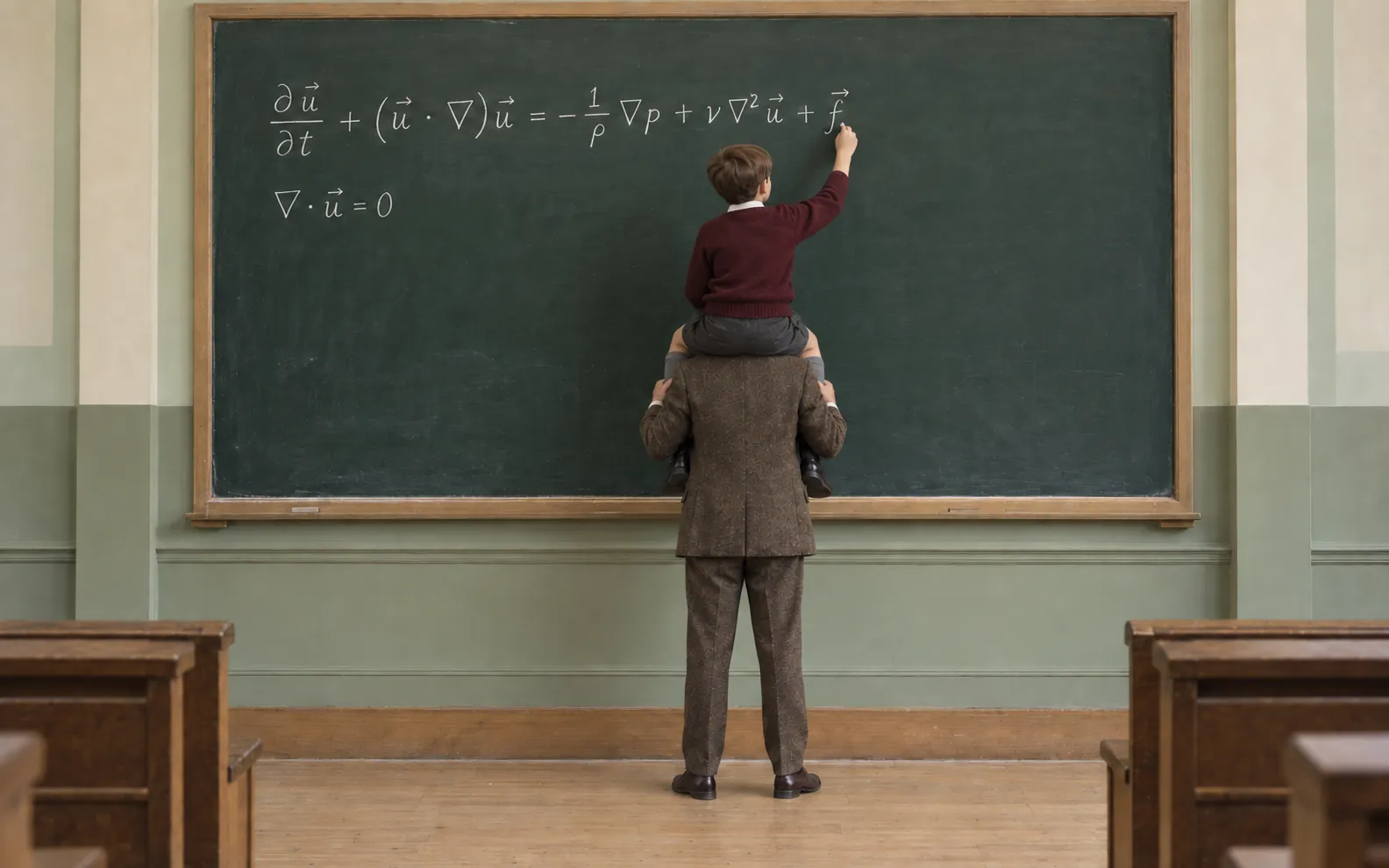
I am a mathematician and a computer scientist, with enough training to appreciate a breakthrough and enough experience to know that appreciating one is considerably easier than producing it.
My first reaction to OpenAI’s proposed solution of the Navier–Stokes Millennium Prize Problem was therefore uncomplicated: extraordinary.
My second reaction, watching the argument about intellectual ancestry, was to wonder where everyone thought mathematics came from. Has anyone located a scientist who developed an important discovery without inherited concepts, earlier results, borrowed techniques, or teachers? Even the blackboard usually belongs to somebody else.
Scientific originality has never required intellectual virgin birth. We stand on the shoulders of giants. Apparently, the latest arrival has brought computing infrastructure.
First, however, the water.
The Navier–Stokes equations describe the motion of viscous fluids. They help us understand phenomena as familiar as flowing water and moving air. Their mathematical difficulty lies partly in a troublesome feedback loop: the fluid’s velocity helps determine how that velocity changes. Meanwhile, viscosity smooths things out. In three dimensions, the competition becomes exceptionally difficult to control.
The famous question concerns whether initially smooth motion remains smooth indefinitely under the specified conditions, or whether a singularity can develop in finite time. The official problem permits several routes to an answer, including a breakdown under a suitably smooth external force. Mathematics has attached a million dollars to establishing exactly how badly a fluid can behave. Clay’s problem description
On September 8, OpenAI published a proposed solution, accompanied by a mathematical paper and a formalization in Lean.
The paper constructs a three-dimensional flow that starts at rest, experiences a smooth external force, and develops unbounded velocity while its total kinetic energy stays bounded. The intense motion concentrates into an increasingly small region. A carefully constructed system of corrections keeps the external force smooth even as the velocity becomes singular. This addresses alternatives C and D of the official problem. It does not establish blowup for Navier–Stokes without external forcing. OpenAI’s paper
Your kitchen tap has consequently received no instruction to become a particle accelerator. The result concerns the limits of a mathematical description of fluids, under particular conditions. Ordinary engineering does not become invalid whenever mathematics discovers an extraordinary counterexample.
According to OpenAI, the successful group involved roughly 10,000 concurrent agents powered by an internal model more capable than GPT-6 Astra. The solution emerged about 88 hours after the effort began; formalization and verification took another 17 hours using Astra. Humans organized the effort and redirected resources as results emerged. OpenAI’s account
This is a substantial revision to the traditional image of a mathematician alone with a pencil. It also suggests that the next generation of research seminars may require its own electrical substation.
The achievement deserves serious attention. Producing a new argument, then expressing it in a form that a proof checker can inspect, goes far beyond reciting familiar mathematics. OpenAI has published the formal proof materials and instructions for independent checking. Specialists still need to scrutinize the mathematics and its correspondence with the formal statements. A proof checker verifies what has been encoded; human understanding remains part of the job. Published verification materials
There is also a distinction between publishing a proposed solution and receiving institutional recognition. Clay’s prize rules require publication, a waiting period of at least two years, and general acceptance by the mathematical community. Even infinity must wait for the committee. Clay’s prize rules
Where, then, do the two unhappy mathematicians enter?
Tristan Buckmaster and Levent Alpöge had published results on related fluid equations, including three-dimensional Euler with smooth forcing. They used Claude and Codex extensively. Buckmaster explicitly credits Diego Córdoba and Luis Martínez-Zoroa with the underlying research programme. These are researchers participating enthusiastically in cumulative, AI-assisted mathematics. Buckmaster’s statement
Their concern deserves to be described accurately.
Buckmaster found OpenAI’s pursuit of the same less-travelled route suspicious, given the timing. Their unpublished drafts had been passing through Codex. He says that when he asked whether those sessions had been used in training, the initial answer addressed access to user data but left training unanswered. He also describes pressure over publication and a proposal for him to present OpenAI’s result without Alpöge, whose Anthropic employment had become an issue. Crucially, he explicitly says he did not know whether their data had been used. His account of the discussions
OpenAI denies that its researchers or agents saw their unpublished work or accessed specific user data to solve the problem. It nevertheless leaves open the possibility that de-identified data from their product usage contributed to model improvement, while describing that possibility as unlikely. The company also says its proofs differ substantially from theirs. OpenAI’s response
Sébastien Bubeck’s subsequent explanation adds another distinction: he denies seeking to remove Alpöge from authorship of Alpöge’s own work. He says the discussion concerned authorship of a rewrite of OpenAI’s proof, where he regarded employment at Anthropic as an obstacle. He also apologized for his language about risking a career. Alpöge, meanwhile, said he would have welcomed collaboration and regretted how the discussions unfolded. Bubeck’s response, Alpöge’s response
Fluid dynamics, it seems, has made faster progress than academic diplomacy.
Here the shoulders-of-giants argument reaches a necessary boundary. Published knowledge is the shared foundation of research. Unpublished notes entrusted to a service create a different expectation. A library and a private notebook can contain identical mathematics while carrying very different obligations.
If confidential work were used improperly, a resulting discovery could still be magnificent. Its magnificence would not settle the question of conduct. Equally, suspicion about provenance does not establish theft. Choosing the same promising direction is evidence worth examining, not a verdict.
The broader dismissal of AI because it builds on human work remains peculiar. Every mathematics department is an elaborate mechanism for teaching people what other people discovered. We then hope that someone will connect those ideas in a way nobody managed before. Why should a successful new connection become unimpressive when the connecting machinery changes?
Buckmaster himself ends by saying that an OpenAI advance to Navier–Stokes would deserve loud celebration, with the history preserved. That seems an excellent standard. Buckmaster’s concluding remarks
We can admire the machinery, examine the proof, acknowledge the predecessors, and insist on trustworthy treatment of researchers. These activities fit comfortably inside the same head.
The giants can take the weight.
We should make sure they remain in the acknowledgements.


No comments yet