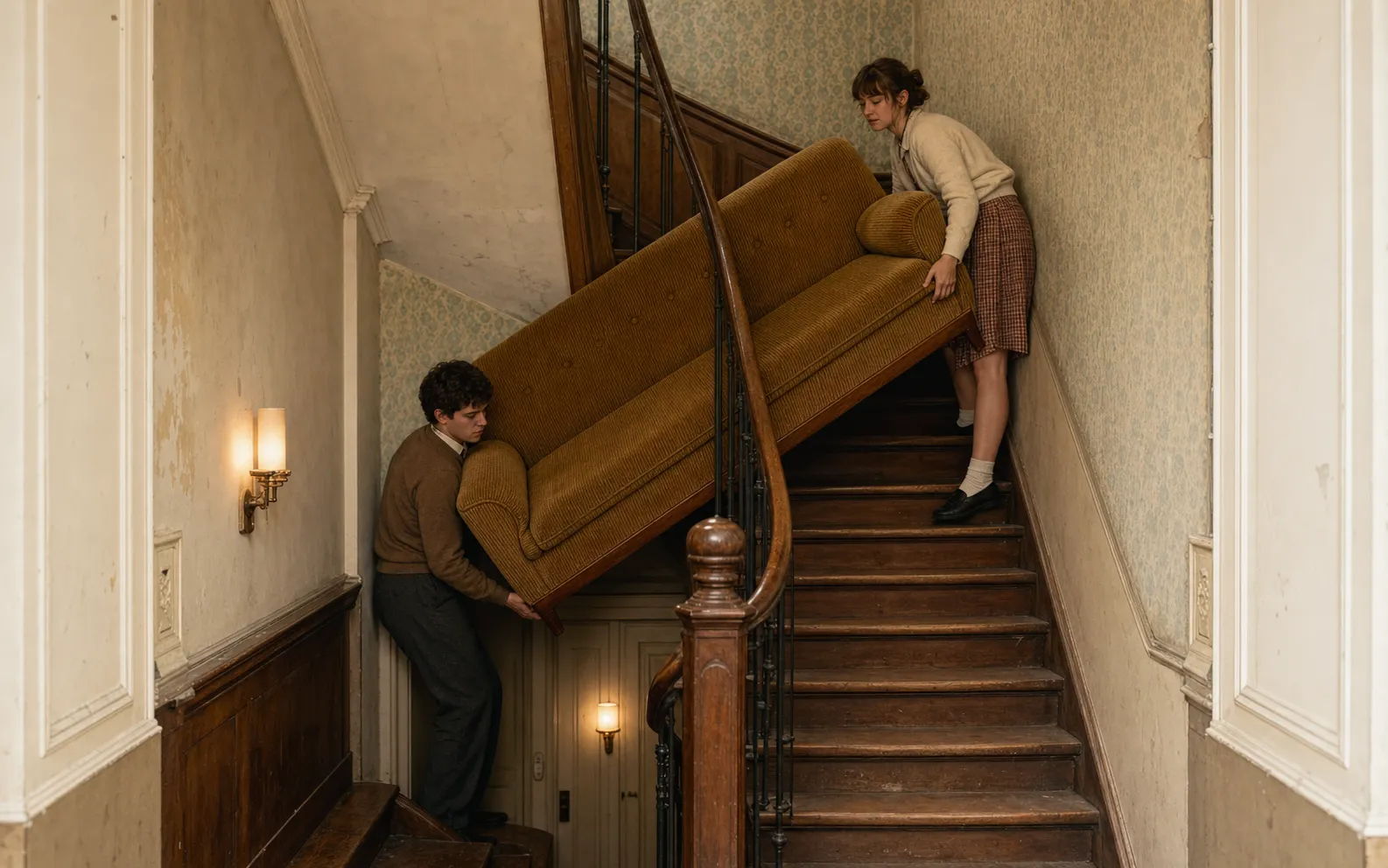
Artificial intelligence has enjoyed a peculiar childhood. It has read more books than any prodigy, memorised half the internet and discussed cities it has never crossed. Ask it about Paris and it can summon Haussmann, croissants and the Métro. Ask whether a sofa will fit around a narrow staircase, and suddenly our digital savant becomes a confident estate agent with no legs. Language models know what the world says about itself. What they lack is the long education delivered by knees, doorframes, missed buses and the discovery that “five minutes away” depends heavily on whether it is raining.
Google Research’s new work on Mobility-Embedded Points of Interest, or ME-POIs, offers an intriguing remedy. Its central distinction is simple and excellent: a place has an identity and a function. A textual model may know that two establishments are coffee shops on the same street. Human movement reveals that one processes commuters in six-minute bursts while the other accommodates laptop settlers for geological periods. The sign above the door says what the place is; the choreography of bodies says what it does.
The framework converts visits—the coordinates, arrival time and departure time—into numerical representations. A transformer studies sequences of visits, while contrastive learning pulls each observed visit toward a stable embedding for the relevant place and pushes it away from others. Textual descriptions are then aligned with this mobility signature. In effect, the model receives not just a noun but a verb: not merely “restaurant,” but “fills at noon, empties at two, revives after work.” The city stops looking like a directory and begins to acquire a pulse.
There is also a clever answer to the obscure-shop problem. Famous landmarks generate abundant mobility data; the tiny repair shop behind the laundrette does not. ME-POIs borrows patterns from well-observed neighbours at several distances—roughly street, block and district scales—to give sparse locations a regional prior. This is statistically sensible and faintly sociological: if the model knows nothing about you, it asks what the neighbours are doing.
The reported gains are substantial. Across five map-enrichment tasks, adding mobility improved predictions of opening hours, permanent closure, visit intent, busyness and price level. The largest relative gains reached 81.9 percent for visit intent and 75.1 percent for price classification; busyness error fell by as much as 24.7 percent. In some cases, mobility without text even beat text-only embeddings. Our feet, it appears, write sharper reviews than our adjectives. The underlying paper reports the complete experiments and comparisons.
But we should resist promoting the result into an artificial childhood. ME-POIs does not give a language model a body, proprioception or a general understanding of three-dimensional space. Its locations are encoded primarily as two-dimensional coordinates, enriched by time of day, day of week and visit duration. The “fourth dimension” here is not a lived passage through spacetime so much as a very competent timetable. The model learns that a gym becomes active after work; it does not learn how a person rotates a shoulder to pass through its turnstile.
That distinction matters for spatial hallucinations. A model that invents a nonexistent bridge, reverses left and right after several turns or proposes putting a refrigerator through a letterbox is suffering from more than a shortage of foot-traffic statistics. Such failures involve geometry, perspective, object permanence, scale, causality and uncertainty. Mobility embeddings can correct what a place is like in aggregate. They cannot by themselves tell an agent what is behind it, whether the floor continues beyond the doorway or what will happen if it pushes the red trolley downhill.
The evidence also has boundaries. The paper evaluates about 68,000 points of interest in Los Angeles and Houston. Los Angeles contributes a year of mobility from 2019; Houston contributes only twenty days in March 2020, a period when “normal urban rhythm” was preparing to become an historical genre. Transfer from neighbouring venues may rescue sparse data, but it may also import a neighbourhood’s assumptions into a business that genuinely differs. Inferring price from movement is useful; it is also a reminder that mobility contains socioeconomic structure, including its biases. “Aggregated and anonymised” reduces privacy risk, but the history of location data advises continued seriousness rather than ceremonial reassurance.
None of this diminishes the achievement. It places it correctly. ME-POIs supplies grounding by observation, not embodiment by experience. It lets AI borrow the collective traces of people who did have bodies: people who arrived, lingered, departed and occasionally realised the café had closed six months ago despite what the listing claimed. The method converts human routine into a kind of distributed sensor.
The deeper lesson is that places are not coordinates with biographies attached. They are recurring events. A railway station is a morning compression followed by an evening release. A nightclub is an empty room with excellent metadata until midnight. A park changes function with weather, season, daylight and the local tolerance for frisbees. Teaching models these rhythms brings them closer to our environment because human space is always space-in-use.
To go further, mobility will need companions: vision that understands depth, simulations that preserve physical consequences, agents that act and receive correction, maps that update, and models trained to admit when the route in their head is merely plausible. Give AI our movement patterns, certainly. Then give it surfaces, obstacles, gravity, viewpoints and the possibility of bumping into things—preferably in simulation, for the sake of the furniture.
Spatial hallucinations will not vanish because a model has learned when Los Angeles buys coffee. But they may become less comfortable. The library-raised genius has finally been allowed to watch the street. It is not yet walking among us; at least it now knows that the bar is busiest at eleven, expensive on Saturdays and, rather importantly, permanently closed.


No comments yet