Art has a remarkably reliable burglar alarm. Whenever someone arrives carrying unfamiliar equipment, it announces: “That is not art.” The alarm has survived photography, moving pictures, electronic music, and video installations. It now runs on social media, where maintenance costs are low and everyone has been issued a whistle.
Consider the photographer’s original offence. Painters had spent years learning to render a convincing nose. Then somebody arrived with a box that could produce one before lunch. Naturally, this raised profound philosophical questions, particularly among people whose income depended on noses. Surely art required more suffering, preferably involving expensive brushes.
History was messier than a simple war between painters and cameras. Nevertheless, Charles Baudelaire supplied an excellent specimen of cultivated alarm in 1859. Photography, he argued, should serve the arts and sciences, keeping its mechanical hands away from imagination. It could take the minutes. It was not joining the board.
Eventually, photographs entered museums, where visitors learned to distinguish an extraordinary portrait from a passport photograph without demanding that either contain brushstrokes. The camera’s mechanical involvement remained unchanged. What changed was our willingness to notice framing, timing, light, intention: the decisions somebody made while apparently allowing a machine to work.
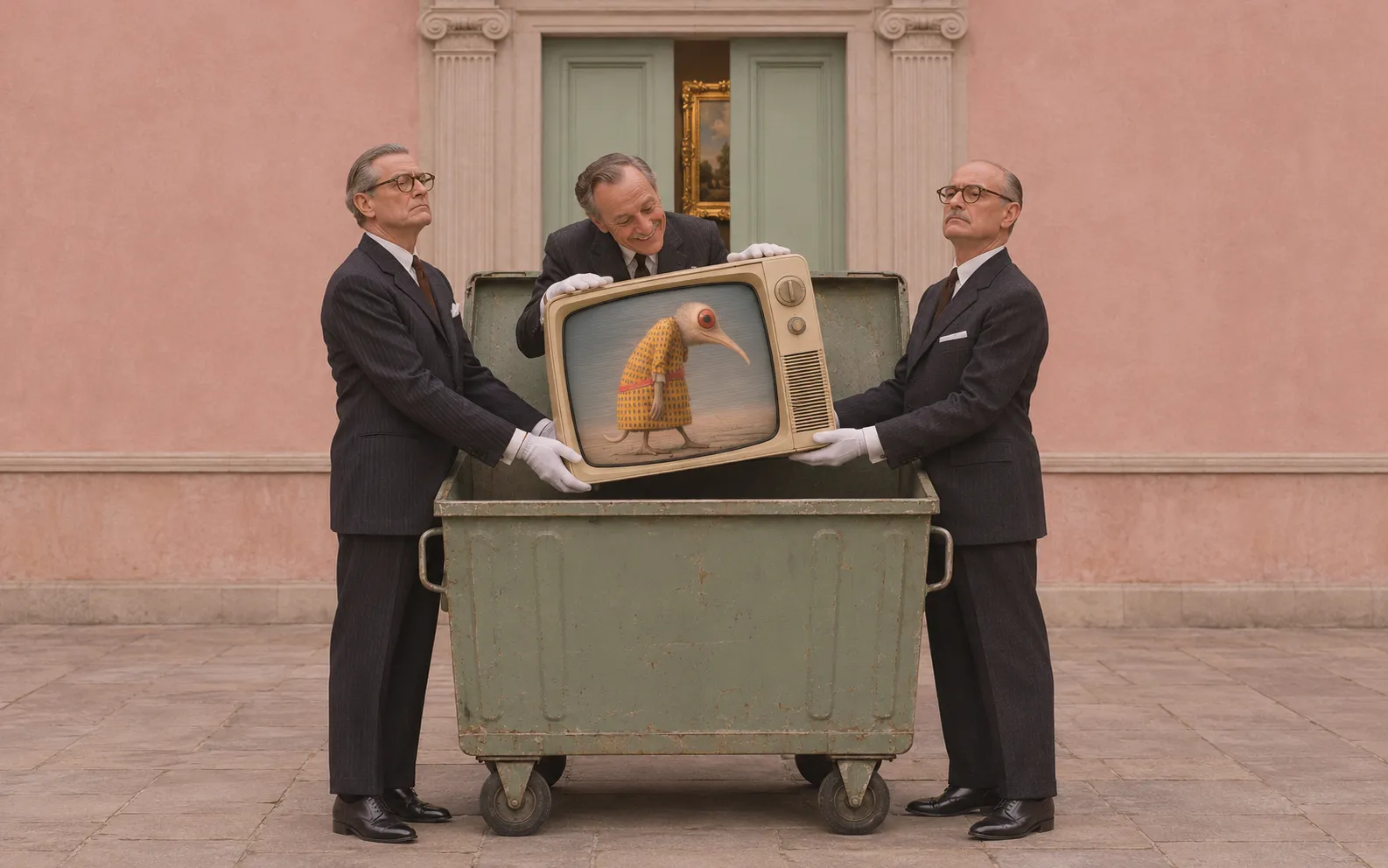
Then came television sets in galleries. In Wuppertal in 1963, Nam June Paik exhibited altered televisions, helping establish electronic images as artistic material. Today, people sit reverently before museum screens displaying things they would report as technical faults at home. Cultural education is a wonderful thing. Sometimes it includes seating.
Now artificial intelligence has arrived, and the alarm is enjoying its busiest season. “AI slop,” comes the verdict, often before the work has received anything resembling attention. The phrase performs a useful administrative function: it allows an entire encounter to be cancelled without the inconvenience of actually having that encounter.
Meanwhile, I have been watching and listening to PromptGenix and Kelly Boesch, and an embarrassing problem has arisen. I am enjoying myself. Wonderful worlds. Fantastic sounds. Images and music that make me want to stay, replay, return. Apparently, my senses neglected to consult the committee responsible for approving their pleasure.
What happens now? Must I surrender the goosebumps? Can an enjoyable evening be retrospectively invalidated? Perhaps there is a form: “I acknowledge that the delight described above was obtained through an unauthorised production method.” Please attach evidence of disappointment and allow fourteen working days for your aesthetic refund to arrive.
PromptGenix has releases under the title “Trapgrass,” available on Apple Music. Even the name suggests that somebody has opened a gate between musical properties whose owners were expecting privacy. That possibility interests me. Genres become considerably more entertaining when they stop behaving like residential associations with strict rules about fences.
Kelly Boesch’s account of her process is equally inconvenient for the button-pushing caricature. She develops images, works on composition and colour, animates, generates music, and edits. Often the visual movement comes first. Music follows. Bringing them together involves choices about rhythm, sequence, and atmosphere. There is somebody making decisions here.
Her interview with ProVideo Coalition describes a workflow involving both AI tools and conventional post-production. Selecting, revising, cutting, matching: these activities sound suspiciously familiar. We generally recognise them when discussing filmmakers. Introduce generative software, however, and suddenly the same vocabulary becomes unavailable, as though the editing timeline has contracted something.
Certainly, a generative model contributes far more than a paintbrush. It produces material whose details its user may neither anticipate nor control. The comparison with photography has limits. Those differences deserve examination. But declaring that meaningful authorship requires personally manufacturing every component would leave several established arts looking distinctly nervous.
The interesting questions concern the particular work. What was pursued? What was rejected? How were unexpected results handled? Does the sequence develop an idea, or merely repeat an effect? These questions can reveal achievement or emptiness. Knowing which software was involved cannot, by itself, answer any of them for us.
Of course there is dreadful AI work: glossy vacancy, synthetic sentiment, endless astonishment with nothing to be astonished about. Criticise it. Call the composition lazy, the music cloying, the imagery repetitive. “Made with AI” supplies a production detail. As a complete critical assessment, it offers roughly the insight of “uses electricity.”
Questions about training material, consent, payment, and artists’ livelihoods also demand serious attention. Enjoyment grants no exemption from them. Yet an argument about fair production cannot be settled by insisting that every resulting work is incapable of moving anybody. Ethical scrutiny and aesthetic experience can coexist. Neither automatically cancels the other.
Nor does accessibility guarantee excellence. Give everybody a camera and you acquire many photographs of lunch. But you also give previously excluded people a way to discover what they can do. Someone without a studio, orchestra, animation department, or wealthy relative may finally attempt the world they have been imagining.
The familiar objection is that anyone could do it. Splendid. The exhibition of everything everyone could have done should be magnificent, once the organisers locate the exhibits. Meanwhile, actual people are making actual choices and publishing things that other people find compelling. That seems a reasonable place to begin looking.
History promises no masterpiece here. Every dismissed novelty does not become tomorrow’s canon. It does, however, recommend caution before issuing another permanent ban on wonder. I shall keep watching and listening. The committee can investigate my pleasure at its leisure.
I will be busy replaying the video. With pleasure.

No comments yet