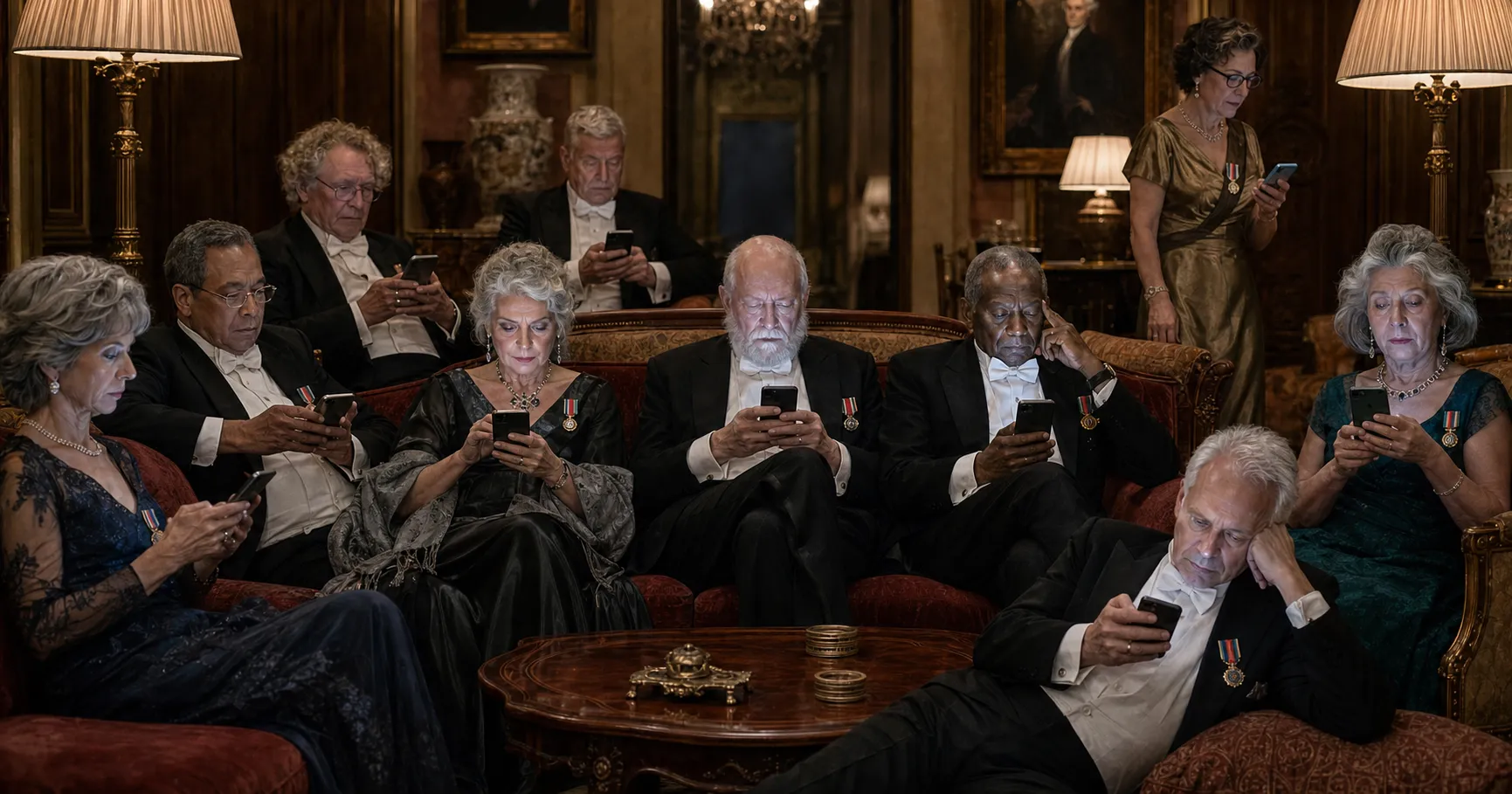
How could anyone possibly have seen this coming? Apart from computer scientists, science-fiction writers, economists, trade unions, and every employee who has watched a manager discover “AI-enabled efficiencies,” there was simply no warning. Artificial intelligence arrived like a meteor in the night, if meteors spent fifteen years giving TED Talks, raising venture capital, and announcing their estimated impact on employment.
And so, at last, humanity’s most dependable emergency service has entered the building: a website. “We Must Act Now,” it declares, supported by hundreds of economists and AI researchers, including an impressive bouquet of Nobel laureates. The statement is four sentences long. Admirable efficiency. Why describe who should do what, with whose money, and against whose interests, when one can request “incentives, guardrails, and institutions”? These are the policy equivalent of scented candles: they suggest responsible adulthood without requiring anybody to locate the fuse box.
“Now” is a particularly beautiful word. It means the precise moment at which respectable people become anxious in public. Before now, there was investment, disruption, scaling, and the thrilling liberation of workers from their livelihoods. After now, there will be panels, summits, and photographs of thoughtful people gazing toward a future they have just noticed. Someone will say “human-centred.” Someone else will invoice the foundation.
We are told that jobs may be destroyed. This is shocking because technological upheaval was always charming when it happened to somebody else. The loom displaced weavers; machinery displaced farm labourers; software displaced clerks. Economists called this creative destruction, a phrase with the moral cleanliness of a drone strike. But now the machine can produce a strategic memo, a mediocre logo, and a summary of a report nobody read. Suddenly the professional classes have discovered that “disruption” is less exhilarating when it knows PowerPoint.
Naturally, we must think of the children. We must always think of the children, those small, solemn shareholders in every argument. Nobody invokes children to discuss cheaper school lunches or adequately funded libraries; that would be vulgar and specific. Children are summoned when an adult wants moral force without administrative detail. Our children’s future is at stake! Quite so. Which future? The one in which they work three jobs because productivity gains flowed upward? The one in which they enjoy shorter working weeks because society chose to share those gains? Or the one in which they spend adolescence learning to “collaborate with AI” so they may compete for an internship supervising the machine that eliminated the entry-level position?
The child, in modern rhetoric, is less a person than a decorative alarm bell. Ring firmly and all objections become suspect. Do you question the proposed guardrail? You monster—have you no concern for the little ones? Yet the children themselves remain curiously absent, presumably because they are busy training tomorrow’s models with today’s homework, accepting terms of service no adult has read, and explaining to their parents why the printer is not, in fact, connected to Bluetooth.
Then come the Good People: the guardians of conscience, freshly mobilised and beautifully branded. They do not merely worry; they curate worry. Their alarm arrives with a serif font and a button marked “Add Your Name.” Their genius lies in converting helplessness into a mailing list. Sign here, and history will record that you stood on the correct side of an issue whose remedy remained tastefully unspecified. Future generations will whisper: they built no safety net, altered no tax code, challenged no concentration of power—but, by God, they endorsed the statement.
Still, it would be too easy to laugh the whole thing away. Vagueness does not make the danger imaginary. AI may create extraordinary wealth while stripping bargaining power from the people whose work trained, fed, and checked it. Mass displacement is not a weather event. It is a distributional decision wearing a lab coat. If benefits are privately owned while costs are handed to workers, the resulting misery will not be caused by intelligence, artificial or otherwise. It will be caused by policy: human stupidity with letterhead.
That is why “we must act now” is both correct and magnificently insufficient. Who is “we”? Governments that compete to subsidise data centres? Companies promising to protect workers immediately after promising investors they will need fewer of them? Economists who can model a productivity boom to three decimal places but become misty when asked who receives the productivity? The passive voice has never had so many distinguished signatures.
Perhaps the first useful guardrail would be against sentences without subjects. Let us replace “workers may be displaced” with “firms may dismiss workers to increase returns.” Replace “society must prepare” with “legislatures must decide how income, ownership, time, and risk will be shared.” Replace “think of the children” with “fund their schools, protect their privacy, and build an economy in which adulthood is not an endless audition for software.” This would be less uplifting than a pledge, but considerably more annoying to the people who matter—which is usually a sign that politics has begun.
So yes, act now. Hold the summit. Commission the report. Assemble the Nobel laureates and arrange them attractively around the moral emergency. But after the group photograph, kindly remain in the room. Name the winners. Name the losers. Name the bill, the tax, the right, the prohibition, and the institution. Otherwise, the children may grow up to discover that we did foresee everything: the vanished jobs, the concentrated wealth, the brittle society, the elegant website. We simply mistook the publication of our concern for the exercise of power.


No comments yet