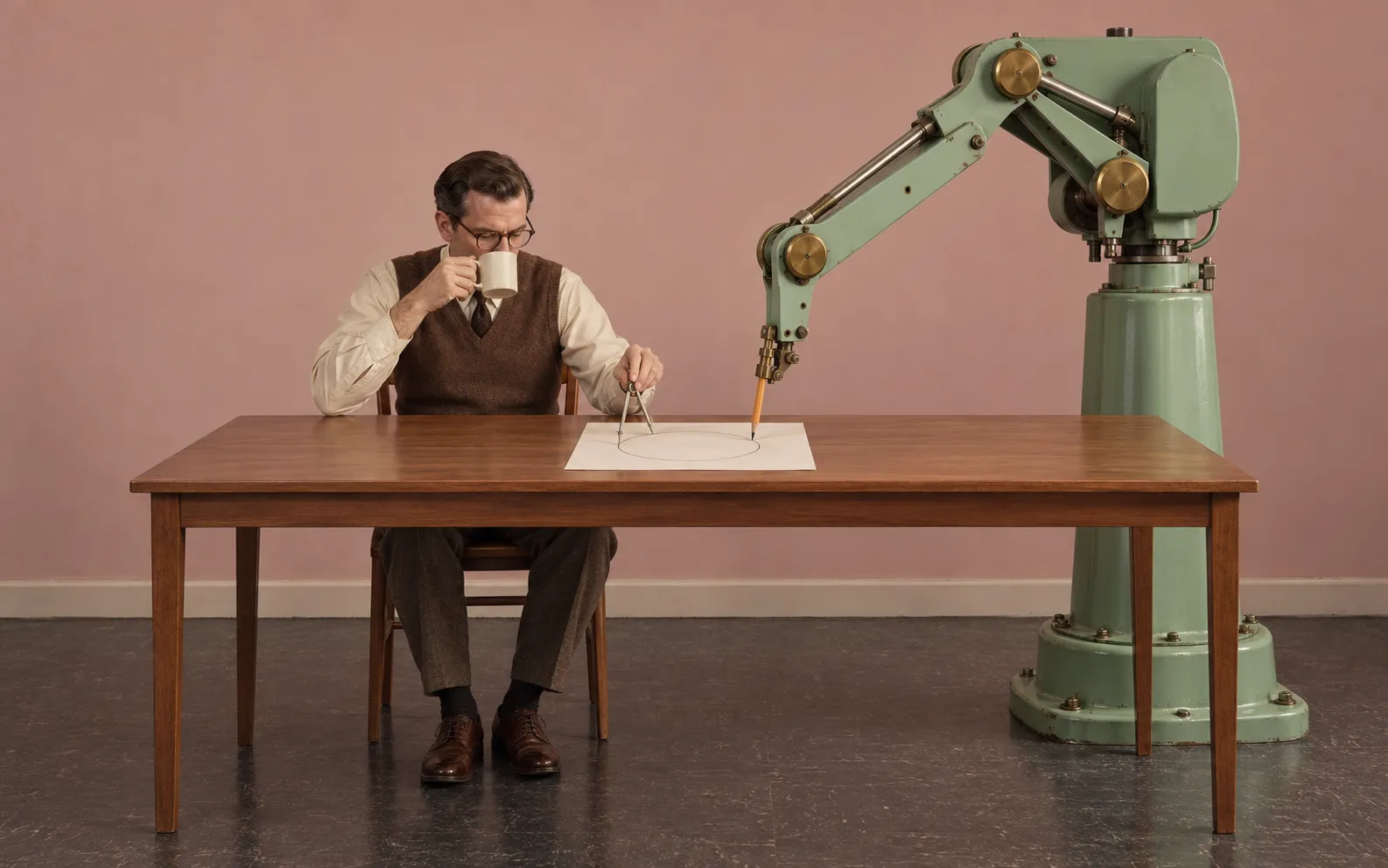
Apparently, I am supposed to feel threatened. I am a mathematician and a computer scientist, and machines are beginning to perform activities that once justified my coffee consumption. They write programs, investigate problems, and now arrive bearing manuscripts with titles like The Exponential Time Hypothesis Is False. The appropriate response, I gather, is professional anguish. Unfortunately, my first response is to ask whether the argument works. Occupational conditioning is difficult to overcome.
Read together, Zhenfeng Cao’s The End of Software Engineering and the OpenAI ETH manuscript offer an entertaining double bill: a forecast of changing intellectual labour, followed by a claimed mathematical breakthrough. Their connection is conceptual. The mathematical result does not establish Cao’s predictions about engineering, and his predictions supply no lemma for the proof. Sharing a revolutionary atmosphere is insufficient for a dependency graph.
Cao’s useful observation is that agents can plan, generate code, execute it, and revise their approach. Code can become an intermediate instrument rather than the product somebody ordered. This is an important shift in how work gets organised. It also sounds rather attractive to anyone who has spent an afternoon writing temporary software to answer a question worth five minutes.
My professional identity has never depended on personally producing every intermediate artefact. I use notation because remembering everything would be inconvenient, compilers because translating instructions manually would be tedious, and libraries because mortality imposes scheduling constraints. A tool that takes over more of the search deserves examination. Its competence does not constitute an insult. I have never asked a calculator to make occasional mistakes to preserve the relationship.
Cao’s attempt to derive inevitability from complexity deserves closer inspection, however. His Proposition 2.1 states growth of Θ(2ⁿ), then invokes 2 raised to n choose two possible dependency graphs. Those are different growth rates, and counting graphs does not establish the difficulty of engineering one system. The apocalypse has arrived with an asymptotic bookkeeping problem. Fortunately, checking the exponent remains a socially useful occupation.
More fundamentally, programmers need not mentally enumerate the search space their programs explore. That is precisely why we invented algorithms. Nor does decomposing a problem into agent tasks automatically make those tasks independent. Dependencies are notoriously unmoved by organisational announcements. Give them a new job title and they will still deadlock before lunch. Better models may help enormously; their superiority requires evidence appropriate to the task.
The ETH manuscript makes a much more specific claim: for every fixed clause width, satisfying assignments can be counted exactly by a deterministic algorithm in subexponential time and polynomial space. Its machinery includes shared linear summaries, polynomial interpolation, and, for sharper bounds, tensor contraction. Here the interesting question is whether the construction and its accounting survive scrutiny. The identity of whoever found it cannot substitute for that scrutiny.
If correct, this refutes ETH. It does not establish P = NP, make every hard problem easy, or guarantee that your laptop will solve industrial instances before the kettle boils. Subexponential is an asymptotic description, not a delivery estimate. Conditional lower bounds also remain valid implications when their premises fail; they lose their force as barriers. Mathematics does not delete the library whenever somebody disproves a conjecture.
There is another pleasing detail: the proposed algorithm is deterministic. Running it does not require repeatedly asking a language model to feel optimistic about a Boolean formula. An AI may help discover an algorithm whose subsequent execution is ordinary computation. That distinction matters. A discovery tool can leave behind something inspectable, reproducible, and usable independently of the system that discovered it. This seems an excellent outcome for a tool.
OpenAI’s Lean formalization covers a weaker bound, still sufficient to refute ETH. Independent examination is also invited. Formal checking establishes consequences of encoded statements; researchers must examine their correspondence to the intended claims and develop mathematical understanding. A proof assistant is wonderfully indifferent to prestige. It will reject an invalid step from a celebrated professor with the same administrative coldness it offers a machine.
Understanding remains something I want for its own sake. Even if an oracle supplied every correct answer, I would still ask why the argument works, which structure matters, and what generalises. Those questions can themselves receive machine assistance. I need no guarantee of permanent human superiority to find them interesting. Astronomy would be a peculiar hobby if telescopes were required to see less than astronomers.
There is also the small matter of curiosity. A faster route through familiar work buys time for unfamiliar questions. I would welcome more experiments, more counterexamples, and more opportunities to discover that an elegant idea is wrong before I have organised a seminar around it.
Of course, livelihoods, access, and concentrated ownership deserve serious attention. A powerful tool can rearrange bargaining power, and an employer may confuse increased productivity with permission to discard experience. Training also becomes harder if beginners never practise judging intermediate steps. These are substantive institutional problems. Calling them inevitable consequences of a new interface would merely automate the oldest management trick: presenting choices as weather.
Meanwhile, Cao acknowledges failures in sustained autonomous development. That makes evaluation, memory, and control central engineering problems. There is plenty of work hiding inside the announcement that engineering is ending. I intend to use the tools, inspect their outputs, and enjoy whatever becomes possible. If one finds a theorem I missed, I shall ask for the proof, another coffee, and perhaps a better conjecture.



No comments yet