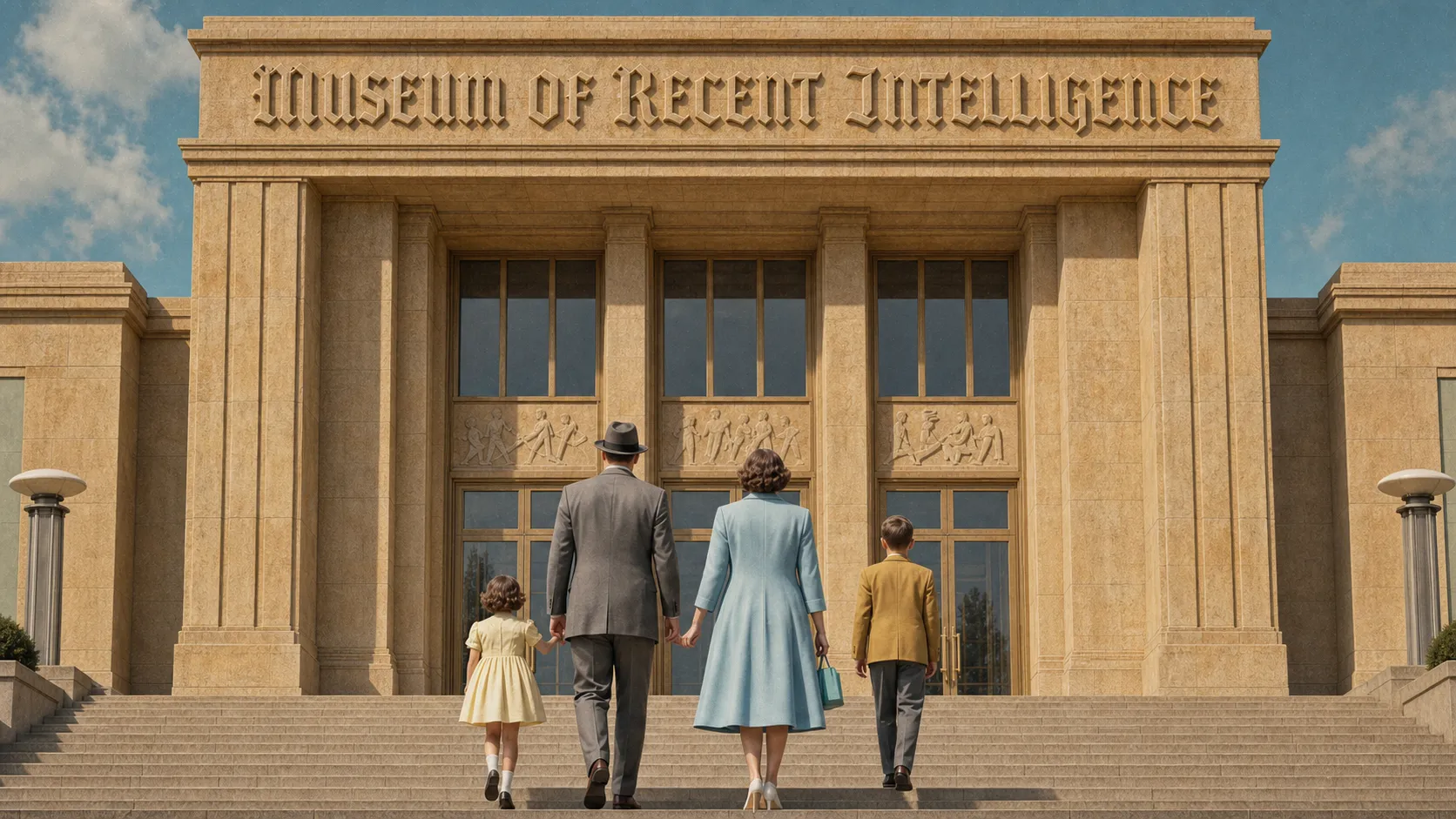
The Museum of Recent Intelligence opened in 2028, mostly because the old science museum had run out of storage.
Every few months, another supposedly revolutionary AI system arrived at its loading dock. Some came with server racks, others with commemorative hoodies and framed magazine covers. All had recently been described as the beginning of a new era. Most were no longer supported by their manufacturers.
The museum’s most popular exhibit was a chatbot from 2024. Visitors were invited to ask it questions while a discreet sign warned them not to rely on the answers. Children competed to make it invent historical events. Adults laughed when it lost track of a simple argument or produced a bride with eleven fingers.
The laughter was affectionate but also reassuring. Nothing makes the present feel intelligent quite like encountering the recent past.
Beside the chatbot stood a plaque:
EARLY GENERATIVE MODEL
DATE: 2024
KNOWN LIMITATIONS: REASONING, RELIABILITY, FINGERS
Farther down the hall, visitors could watch a recording of an old argument from X. One participant had claimed that artificial general intelligence and recursive self-improvement were less than two years away. Another replied that AI from two years earlier already belonged in a museum, so the next two years would surely be mind-blowing.
Beneath them, hundreds of people argued about what “AGI” meant.
Some defined it by test scores. Some required consciousness. Some demanded creativity, autonomy or common sense. One person insisted that the entire idea was laboratory marketing. Another predicted that AI would soon exceed all human intelligence combined. An economist asked whether any of this would make AI companies profitable.
The museum classified the discussion as an interactive exhibit because it was still continuing.
The fictional museum has not yet opened. The argument it contains, however, may already be growing obsolete. The important question is not whether a machine qualifies for admission to the category of human intelligence. It is what happens when the world reorganises itself around a capability that may never resemble human intelligence at all.
“AGI” is a particularly troublesome term because it appears precise while concealing several different questions. Are we talking about a system that can perform most intellectual tasks? One that understands what it is doing? One that can act autonomously? One that possesses consciousness? Or simply one that is better than most people at most economically useful activities?
Our answers depend on what intelligence has meant in our own lives. A mathematician may associate it with abstraction. An entrepreneur may see it as problem-solving. A teacher may include curiosity and judgment. A parent may have discovered that intelligence without empathy can produce extraordinarily sophisticated foolishness.
Ask ten people to define general intelligence and you will receive twelve definitions, three moral objections and at least one podcast recommendation.
But technologies do not need to satisfy our definitions before altering our lives.
An aircraft does not fly like a bird. It has no feathers, no instinct for migration and no particular opinion about worms. Yet it changed transportation because resemblance to a bird was never the relevant criterion. The relevant fact was that it could carry hundreds of people across an ocean.
Likewise, an AI need not think like a person to perform work around which human institutions have been constructed. It does not need to experience scientific curiosity to suggest a useful experiment. It does not need to love programming to produce working software. It does not need to understand justice as a human judge does in order to influence bail decisions, insurance claims or tax investigations.
The practical question is therefore not, Is it intelligent like us?
It is, What can it do—and what will we do because it can?
This distinction matters economically. Human cognitive labour has always been scarce. Expertise takes years to acquire. Attention is limited. Even brilliant people must sleep, become distracted and occasionally attend departmental meetings.
Much of the value of lawyers, engineers, researchers, consultants and managers derives not only from their knowledge, but from the fact that competent judgment cannot be copied ten thousand times at negligible cost.
AI challenges that scarcity long before it achieves any universally accepted form of AGI.
If one engineer assisted by AI can do the work previously assigned to ten, the economic effect does not depend on whether the system truly understands engineering. If it can produce a hundred plausible drug candidates overnight, none of the molecules will refuse to function because their designer lacked consciousness. If companies reorganise their workflows, reduce hiring and concentrate more responsibility in fewer people, the change is real even if philosophers remain unconvinced.
This does not mean that every AI company will become immensely profitable. The skeptics in the original discussion raise an important objection: if several laboratories develop similar capabilities, competition may make machine intelligence cheap. A technology can create enormous value without allowing its inventors to capture most of it. Electricity transformed civilisation, but selling an additional unit of electricity is not always a miraculous business.
Advanced AI could therefore become both one of history’s most consequential technologies and a disappointing investment for many of the companies building it. The future is under no obligation to make social importance and shareholder returns identical.
Recursive self-improvement introduces a different threshold. The phrase suggests a machine locking itself in a server room and emerging the following morning as a digital deity. The reality may be less cinematic.
AI systems already assist with writing code, designing experiments, analysing errors and proposing improvements. Humans may remain involved at every stage while becoming less important to each iteration. The crucial question is not whether a machine can create its successor entirely by itself. It is whether AI can shorten the cycle from capability to improved capability—and whether that cycle becomes faster than our institutions can absorb.
There is a similar problem with human control.
A machine may remain officially an adviser while becoming increasingly difficult to ignore. If its medical recommendations are consistently better, doctors who reject them will have to justify themselves. If its forecasts outperform those of human committees, the committees may gradually move from making decisions to approving them.
No dramatic surrender is necessary. Human authority can remain intact on paper while becoming expensive, unusual and professionally dangerous to exercise.
This is why the decisive threshold may lie outside the machine.
AGI will not necessarily arrive at the moment a model experiences its first genuine thought—an event we might never be able to identify. It may arrive when employers, universities, laboratories and governments begin behaving as though machine capability is general enough to reorganise work, knowledge and responsibility.
We may still be debating whether AI is truly intelligent when companies stop training junior employees because machines perform the junior work. We may still be discussing consciousness when scientific discovery changes pace. We may insist that humans remain in charge long after no individual human can meaningfully evaluate the systems on which the organisation depends.
By then, the definition will be less important than the dependency.
The Museum of Recent Intelligence will therefore contain more than obsolete machines. It will preserve obsolete assumptions: that intelligence had to resemble ours to compete with ours; that tools remained tools until they became conscious; that human control existed wherever a human signature appeared at the bottom of a decision.
Near the exit, perhaps, visitors will find one final plaque:
EARLY TWENTY-FIRST-CENTURY ERROR
HUMANS KEPT ASKING WHAT THE MACHINE WAS.
THE MACHINE CHANGED WHAT HUMANS WERE FOR.



No comments yet