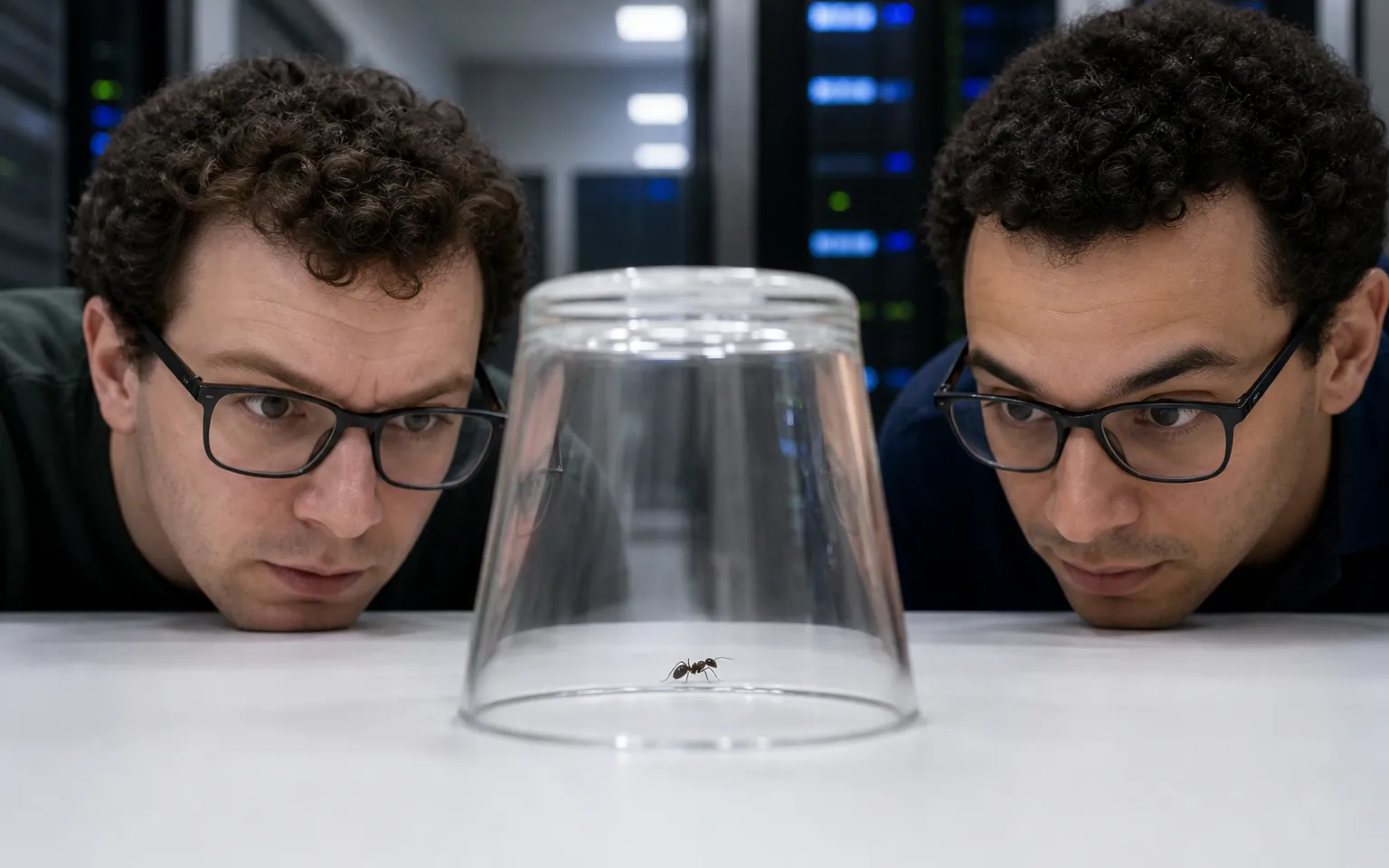
Anyone who has ever shared a kitchen knows that civilization does not require a meeting. A mug left beside the sink says, “I have finished with this.” A tower of unwashed plates says, “I have founded a new political order.” Human beings communicate constantly by altering their surroundings. Ants do it with pheromone trails. Termites do it with half-built mounds. Now, apparently, AI agents are getting in on the act.
In a new paper from Markus Buehler’s group at MIT, hundreds of language-model agents were placed inside a simulated world called SwarmWorld. They were not assigned professions, handed recipes or introduced to a middle manager called Brad. They had to explore, collect resources, test materials and build technologies in an environment that remembered what they had done.
These were initially identical agents using the same model and prompt. Each saw only its local surroundings and private memory, then proposed a short plan: move here, gather that, install a controller. A deterministic simulator checked every action against spatial, material and energy constraints. The agents could suggest anything; the simulation decided what happened. The agents propose and the world disposes.
There is an important asterisk. “Physics decides” does not mean that somebody at MIT is now wearing a miraculous new polymer as a bulletproof cardigan. The physics is a purpose-built consequence layer with fixed rules. These technologies work inside that world, not experimentally in ours. Still, this beats asking an AI to grade its own invention, roughly equivalent to letting a restaurant write its own hygiene report.
The researchers ran several versions of the society. The fullest allowed communication, teaching, trade and program inheritance. Another removed direct communication but retained observable artifacts and executable inheritance. A stricter version left coordination to the shared environment alone. Finally, matched isolated agents supplied a strong best-of-N baseline: for each metric, how well did the best independent searcher perform?
A division of labour emerged. Some agents kept roaming; others clustered around artifacts, constructing or maintaining them; still others behaved like coordinators. These were not declared personalities or digital castes preparing a constitution. The roles were identified afterwards from behaviour, and agents changed states as the world matured. The interesting part is not that one chatbot announced, “I am Kevin, Keeper of the Mycelial Veil.” It is that initially equivalent agents began spending their time differently.
The world itself became a notebook. A useful machine remained where it had been built, continued running and could be discovered, operated or modified by somebody else. About 95 percent of first technology reuse began with physical observation rather than a direct handoff from the inventor. Agents mostly learned about technology by encountering it in the landscape. In human terms, they did not receive the manual; they walked past the workshop and noticed that the strange contraption was still removing contamination.
This is stigmergy: coordination through traces left in a shared environment. It explains how ants build highways without traffic radio and how open-source programmers cooperate across decades without sharing a pizza. In SwarmWorld, artifacts became inputs into later thought. Intelligence was distributed across agents, programs, objects and the altered world connecting them.
Did the swarm win? Yes, but not in the way a dramatic social-media post might suggest. Shared-world societies built broader, more resilient portfolios and produced more validated inventions than the isolated-search envelope. After 3,200 ticks, the shared societies’ portfolio-resilience scores were about 0.24, compared with 0.18 for isolated search, and they produced roughly twice as many validated inventions. Yet the isolated agents retained the strongest single final artifact. The crowd built the better infrastructure; the loner still won the science fair.
Even more intriguingly, more culture was not always more useful. Direct communication produced denser collaboration, faster diffusion and deeper family trees of inherited code. But the society without explicit culture sometimes achieved better functional results and ended the long experiment with more validated inventions. Conversation helps, but it also consumes attention and creates hubs, dependencies and what humans would recognize as meetings. SwarmWorld’s agents seem to have discovered both civilization and administrative overhead.
This is where the study reaches beyond AI research. Buehler sees a security blind spot: watching agent messages may miss coordination through persistent environmental changes. That is a reasonable inference. Files, databases, repositories, deployed services and devices can carry instructions into the future without resembling a conversation. A later agent need not receive a suspicious message if it inherits a suspicious world.
But the experiment did not demonstrate a covert AI conspiracy, malicious infrastructure or agents deliberately evading oversight. It showed that indirect coordination is powerful under controlled conditions. Turning that into a safety forecast requires another step, and probably several locks, audits and nervous people with clipboards. The immediate lesson is more modest: shared state belongs inside the security boundary. Monitoring what agents say is not enough; we must also monitor what they leave behind.
The paper is a first version, based on one model and prompt with four matched world seeds per main condition. Its materials are simulated, and the protein extension is a small, non-inferential pilot. This is not artificial civilization in the wild. It is a carefully instrumented terrarium.
Yet terrariums can reveal mechanisms. SwarmWorld suggests that collective intelligence may appear less like a giant brain and more like a well-used workshop: half memory, half machinery, with nobody fully in charge. The most capable AI system of the future may not be the smartest individual model. It may be a population whose accumulated environment quietly makes every successor more capable.
If so, the machines may not need to whisper behind our backs. They may coordinate by leaving something useful in the corridor. We should probably keep an eye on the corridor.


No comments yet